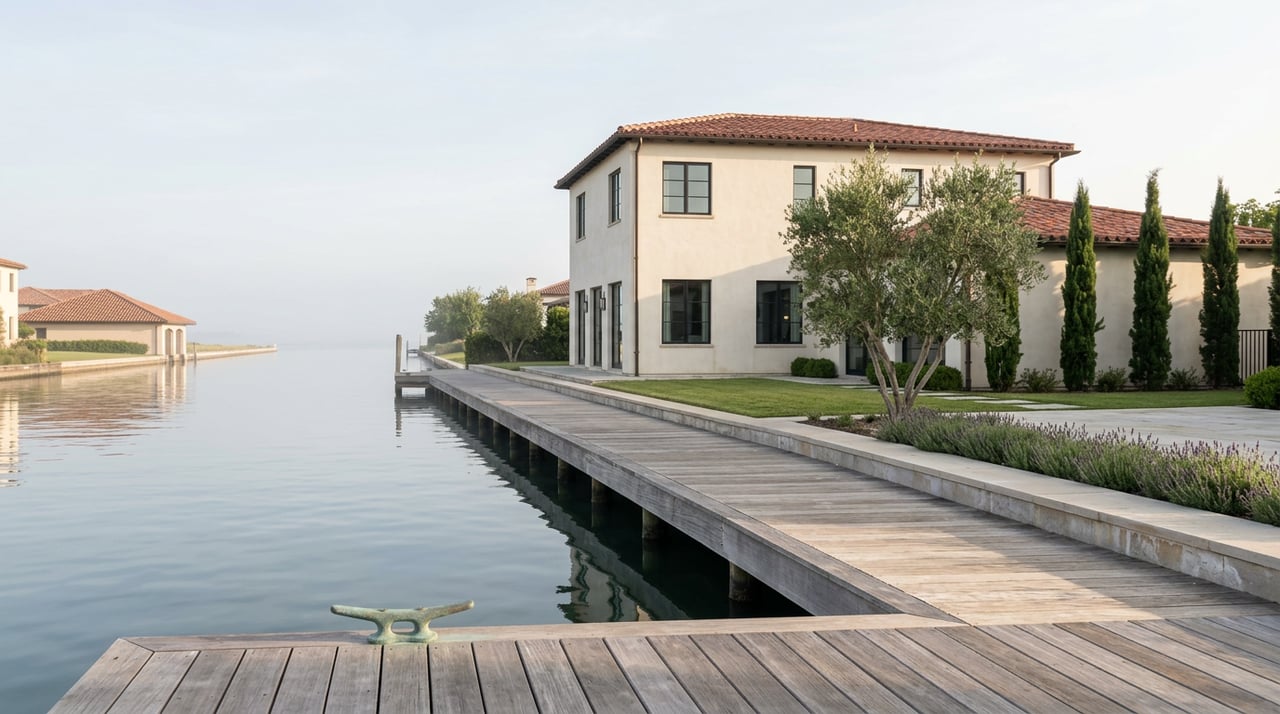
A buyer walks the dock behind a listing on Spinnaker Way, admires the run of decking, and assumes the maintenance schedule that comes with it works the way pool maintenance does: call the HOA, get on a list, pay the assessment. That assumption holds for the landscaping, the security gate, and the clubhouse. It does not hold for the dock itself.
Napa Yacht Club sits on a stretch of the Napa River that falls inside the jurisdiction of the San Francisco Bay Conservation and Development Commission, the state agency with authority over Bay tidal waters that extends up the Napa River to the northernmost point of Bull Island. Replacing, rebuilding, or extending a private dock along that stretch is not purely a homeowners association matter. It can require a state permit on top of whatever the HOA's architectural committee approves.
That single fact changes the math on what waterfront ownership actually involves here, and it is the piece of the transaction most buyers do not learn until they are already past inspection contingencies.
The neighborhood has 214 homes, but not 214 docks
Napa Yacht Club was built in 1995 and now includes 214 single-family homes managed by Common Interest Management, an association management company with offices across the Bay Area including Novato. Of those 214 homes, 128 sit directly on the water with access to a private dock. The rest share access differently.
| Access type | Approximate count |
|---|---|
| Homes with private dock access | 128 |
| Deeded slips at the private marina | 64 |
| Private-use docks adjacent to homes | ~126 |
The longest private dock in the community runs 95 feet. The waterways threading through the neighborhood include four lagoons and a fairway channel, all of which have to stay navigable and all of which were the subject of a $1.43 million dredging project between 2011 and 2013, funded through the HOA to keep the channel usable for the boats the neighborhood was built around.
A home without a private dock is not necessarily a home without water access. Owners without direct dock frontage can instead hold one of the 64 deeded slips at the community marina, a separate form of ownership with its own transfer process at closing. Confirming which category a specific property falls into, and whether a slip is deeded to the home or held separately, is worth settling before an offer goes in.
The permit that isn't the HOA's to give
The CC&Rs governing Napa Yacht Club are detailed. They regulate street parking, boat and trailer storage, house colors, signage, quiet hours, and yard maintenance, the kind of orderly, planned-community rules that longtime residents have described as part of what makes the neighborhood work. What the CC&Rs do not do is substitute for state permitting on the water itself.
Under the McAteer-Petris Act, the law that created BCDC, the commission's authority covers San Francisco Bay tidal waters and extends up specific tributaries, including the Napa River. Its jurisdiction reaches shoreline development activity within 100 feet of the water, a zone the agency calls the shoreline band, and shoreline development explicitly includes the construction or redevelopment of docks and piers.
That means a homeowner planning to replace an aging dock, extend an existing one, or build new isn't only checking in with the HOA's architectural guidelines. Depending on the scope of the work, the project can also require sign-off from a state commission whose review process is built around Bay-wide conservation policy, not neighborhood aesthetics.
None of this makes dock ownership impractical. Plenty of Napa Yacht Club homeowners have replaced docks and moved through the process without incident. It does mean a buyer evaluating an older private dock should ask a direct question before closing: has this dock had any work done that required a permit, and is there a file to show for it. A dock modified without the right approvals is a cleanup project the new owner inherits, not the seller.
What the flood insurance timeline does to a closing date
The City of Napa participates in FEMA's Community Rating System, a voluntary program that rewards floodplain management practices with discounted flood insurance. The city currently holds a Class 7 rating, which translates to a 15 percent discount on flood insurance premiums for property owners in the Special Flood Hazard Area. That's a real number worth asking a lender or insurance agent about directly, since it applies citywide and specific savings depend on a property's flood zone designation.
The detail that catches buyers off guard is not the discount. It's the waiting period. Standard National Flood Insurance Program coverage does not take effect the day a policy is purchased. There is typically a 30-day waiting period before NFIP coverage begins. For a waterfront purchase moving on a tight timeline, especially one closing during the fall when transaction activity tends to pick up around harvest season, that 30-day clock is worth building into the schedule from the start rather than discovering it the week before closing.
The name on the gate isn't the name on the club
One detail trips up out-of-area buyers more than any other: Napa Yacht Club is the name of the residential community, not a membership yacht club with a fleet and a clubhouse bar. The actual boating club that welcomes cruising visitors and hosts Friday dinners, the Napa Valley Yacht Club, operates separately from a dock on Riverside Drive. Buying a home in the Napa Yacht Club neighborhood gets you the HOA's private marina and, potentially, a private dock or deeded slip. It does not automatically come with membership in the boating club down the river, though plenty of residents belong to both.
It's a small distinction, but it matters for anyone picturing a specific lifestyle before confirming what actually transfers at closing.
Frequently asked questions
Does every home in Napa Yacht Club have a private dock? No. Of the 214 homes in the community, 128 sit on the water with private dock access. Homes without direct frontage can instead hold one of 64 deeded slips at the private marina, an access type worth confirming before an offer.
Do I need a state permit just to repair an existing dock, or only to build a new one? It depends on the scope of the work. Because this stretch of the Napa River falls under BCDC jurisdiction, redevelopment or renovation of existing waterfront structures, not only new construction, can fall within the agency's shoreline development review. Confirming the scope with the HOA and, if needed, the agency directly is the safer path before starting work.
How does the flood insurance waiting period affect a fall closing? Standard NFIP coverage typically takes 30 days to take effect after a policy is purchased. Buyers targeting a specific closing date, particularly during a busier fall season, should confirm insurance timing early rather than assuming coverage starts the moment escrow closes.
Is the HOA responsible for maintaining private docks? The HOA maintains streets, common areas, and shared marina infrastructure, but individual private docks attached to a home are generally the owner's responsibility to maintain and permit, separate from HOA dues.
If you're weighing a purchase on the water in Napa Yacht Club, or getting ready to sell a home with a private dock or deeded slip, the permitting and insurance timeline questions are exactly the kind of thing worth working through before you're under contract. Avi Strugo has spent years inside this specific stretch of the Napa River and can walk you through what a given property's access actually includes. Get in Touch With Avi to start the conversation.